The world is a book, and those who do not travel read only one page.” -- St. Augustine

Thursday, July 4, 2019

St. Mary Basilica - Natchez, Miss.


(Observer photos/St. Mary Basilica archives)
Destination: Considered a masterpiece of architecture among Catholic churches in the south, St. Mary Basilica dates to before the Civil War and is an active parish that welcomes visitors.
Masses are offered Sunday at 10 a.m. (with nursery); Saturday at 4 p.m. CST, 5 p.m. DST; Monday-Friday at 8 a.m.
Photos: The interior and exterior of the basilica
Why to go: According to its website, “The construction of this place of worship was begun in 1842 as a cathedral in the newly established Diocese of Natchez, and St. Mary retained this status until 1977.
“Because the church is historically significant, in 1998 Rome granted St. Mary in Natchez, Miss., the elevated status of minor basilica, an honor it now shares with 70 of the 250 dioceses in the U.S. There are two kinds of basilicas. The world’s four major basilicas — or papal basilicas — are in Rome, and minor basilicas — some in Rome and others elsewhere throughout the world — are given special ecclesiastical privileges by the Holy Father.
“The portrait of the Christ on the Cross and his Sorrowful Mother (above) hangs above the main altar. The original fresco was executed by New Orleans artist A. Biorci in 1888 as an adaptation of Guido Reni’s classical painting. In 1931, the deteriorating fresco was replaced by the present painting on canvas. A later restoration of this portrait painted out the minor figures in the original to emphasize the church’s patron, Our Lady of Sorrows.
“St. Mary’s congregation takes pride not only in the Gothic Revival style of the Basilica but also its prayerful setting in the midst of colored carvings, painted ceiling, and ribbed vaulting. Natchez is the birthplace of Mississippi. It is a tourist destination because of its historic antebellum homes, and St. Mary Basilica — also antebellum — is the city’s central landmark.”
(Grand) Kid friendly: As long as the kids know their church manners, they will be fine.
Info: Address — St. Mary Basilica, 107 S. Union St., Natchez, MS 39120 
Phone — 601-445-5616
Website — www.stmarybasilica.org

— Sharon Boehlefeld compiled this story
Send Destinations ideas to seasonedobserver@rockforddiocese.org

Thursday, June 6, 2019

Cathedral Basilica of Sacred Heart -- Newark, N.J.


(CNS photo)
Destination: In addition to being the cathedral of the Archdiocese of Newark (N.J.), the Cathedral Basilica of the Sacred Heart is also an active parish and the site of the first beatification to take place on U.S. soil.
Masses are offered weekdays in English at 7:30 a.m. and 5:30 p.m. (except in July and August) and in Spanish Wednesday evenings at 7 p.m. (except in July and August); Saturdays at 9 p.m. and 6 p.m.; Sundays at 10 a.m. in Spanish and noon in English (with choir).
Photos: Top -- Cathedral Basilica of the Sacred Heart (photo by Bob Roller)
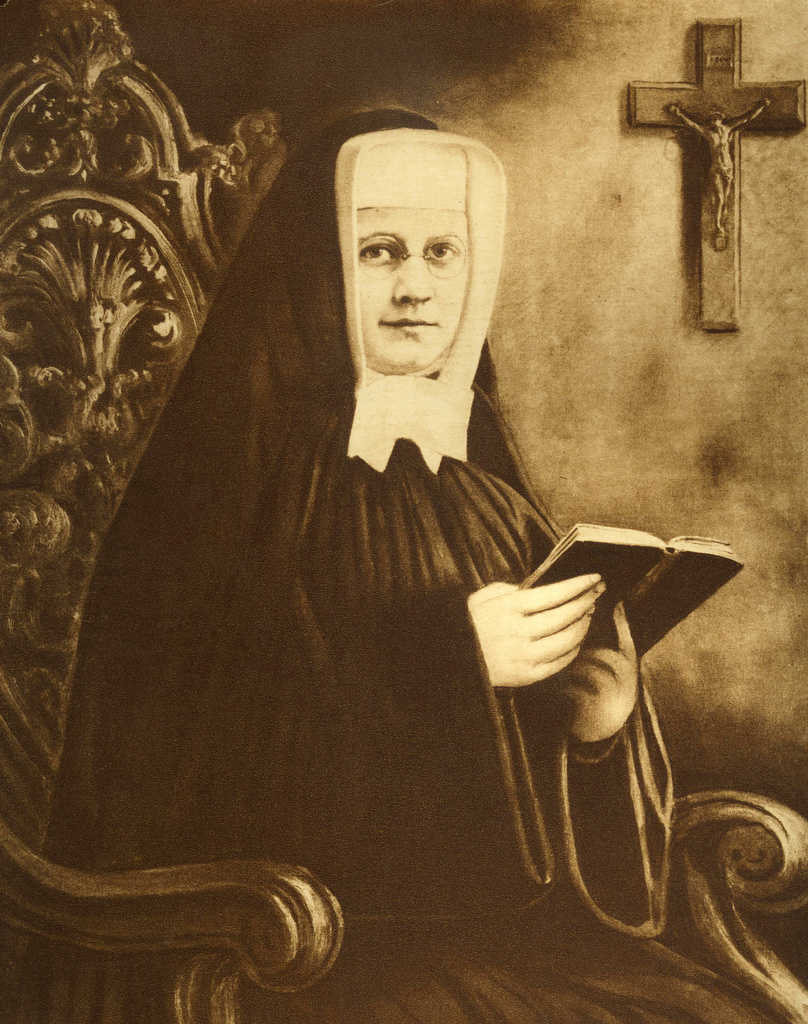
Below -- Sister Miriam Teresa Demjanovich (photo courtesy of Sisters of Charity of St. Elizabeth)

Why to go: Sister Miriam Teresa Demjanovich (left), a Sister of Charity who died at age 26 in 1927, was the first American to be beatified in the United States. Cardinal Angelo Amato, prefect of the Vatican Congregation for Saints’ Causes, was the main celebrant at a Mass Oct. 4, 2014, at the Cathedral Basilica of Sacred Heart in Newark.
(CNS photo)
Sister Miriam Teresa is significant to the diocese because a youngster with advancing bilateral macular degeneration was living in the archdiocese when, in 1964, his sight was restored on a walk home from school. He had just been given a relic and prayer card for Sister Miriam Teresa.
His mother’s letters to the Sisters of Charity explaining what happened remained unnoticed until 1998, so the process of authenticating the miracle did not begin until 2000.
But the cathedral itself is worth a visit. Newark’s first bishop, the Most Rev. James Roosevelt Bayley, proposed it in 1859, although groundbreaking didn’t take place until January 1898. For various reasons, construction was stopped, designs changed and the cathedral wasn’t dedicated until  Oct. 19, 1954, although it had been in use since 1928.
The Gothic-style cathedral features, according to its website, “a towering Botticino marble canopy, or baldachino, ... topped by the figure of Jesus under the title of the Sacred Heart,” a number of chapels dedicated to saints, rose windows and bronze doors made in Rome. 
Accessibility: There is a ramped entrance to the cathedral on Ridge Street and an elevator to restrooms.
Amenities: There is a gift shop inside the cathedral.
(Grand) Kid friendly: As long as the kids know their church manners, they will be fine.
Info: Address — Cathedral Basilica of the Sacred Heart, 89 Ridge St., Newark, NJ 0710   n   Phone — 973-484-4600   n   Website — www.cathedralbasilica.org/

— CNS, Sharon Boehlefeld contributed to the story
Send Destinations ideas to seasonedobserver@rockforddiocese.org
Thursday, May 2, 2019

Museum of the Bible -- Washington, D.C.

(CNS photo)
Destination: Ken McKenzie, Museum of the Bible president and CEO, told Catholic News Service that an upcoming exhibit focusing on science and faith would bolster conversation on the answers to questions on two oft-ignored aspects of science, specifically “what ... science mean(s) for the existence and activity of God” and what science means for the “sacredness of humanity.”
Masses are not offered at the museum, but visit https://masstimes.org/ to find Masses in the area.
Photos: (Top left) Brian Hyland, associate curator from Oklahoma City, interprets a sarcophagus replica of Jonah inside the “Vatican Museums and Vatican Library” exhibit at the Museum of the Bible in 2017.
(Bottom left) A bound book is seen inside the “History of the Bible” exhibit at the Museum of the Bible in 2017.
Why to go: From the 17th-century ban by the Vatican of Copernicus’ mathematical calculation that the sun was at the center of the solar system to modern-day arguments about evolution’s compatibility with a belief in God, science and faith have regularly butted heads in the public square.
Seeking to illuminate these debates for the public is the Museum of the Bible in Washington, which announced April 1 that it would be using sizable grants from the John Templeton Foundation and the Templeton Religion Trust toward fostering a “greater understanding of the shared curiosity about our world that stimulates both scientific inquiry and biblical interpretation.”
(CNS photo)
The exhibits will be divided among six sections, each of which will be devoted to pressing existential questions about the beginning of the universe, what keeps it running, how humans and animals differ, what humans “are made of” and if humanity is alone in the universe.
Accessibility: The museum has stairless entries and wheelchairs — first come, first served — for its patrons. Check the website for details.
(Grand) Kid friendly: Families are welcome to the museum. Cost: (online/at the door) $19.99/$24.99 adults;  $19.99/$19.99 seniors citizens, military, first responders and students; $9.99/$14.99 children 7-17; free child 6 and younger.
Info: Address — Museum of the Bible, 400 Fourth St. SW, Washington, DC 20024
Phone — 866.430.6682  
Website — https://www.museumofthebible.org/

— CNS, Sharon Boehlefeld contributed to the story
Send Destinations ideas to seasonedobserver@rockforddiocese.org

Thursday, April 4, 2019

St. Joseph’s Oratory of Mount Royal -- Montreal, Quebec, Canada

(CNS photo/Gregory A. Shemitz)
Destination:  “The oratory is one of Quebec’s best-kept secrets,” said Guy Cormier, president and CEO of Desjardins Group, who is leading a fundraising campaign for an upcoming renovation at the church. At just over 100 years old, it is one of the newest major churches in Canada.
Masses are offered in English in the crypt church Monday-Saturday at 12:15  p.m., Tuesday and Thursday at 7: 30 p.m. (19:30), and Sunday at 11:15 a.m.; Sunday Masses in the basilica are in French at 11 a.m. and 12:30 p.m. Spanish Mass is offered on Sunday in the Crypt Church at  3 p.m. (15:00) following adoration and the rosary at 2 p.m. (14:00).
Why to go: From the small Chapel of Origin to the great Basilica, the beauty and diversity in the architectural heritage of Saint Joseph’s Oratory make it worth a visit before — and probably during — the upcoming renovation.
The changes are intended to “modernize many of its infrastructures” and, in 2022, after extensive work, “give a new experience” to the 2 million visitors who visit the oratory each year, Cormier said.
St. Joseph Oratory, managed by the Congregation of the Holy Cross, was founded in 1904 by St. Andre Bessette, known as Brother Andre. The oratory is located on Montreal’s famed Mount Royal.
Among its musical treasures is its organ, built by German organ maker Rudolf von Beckerath (1907-1976), and ranked among the top 10 in the world. Some of its 5,811 pipes are as long as 32 feet. Built in 1958 and 1959 in Germany, it took seven months to install it in Montreal. On Nov. 13, 1960, the organ was blessed and played for its first recital by a famous French organist, André Marchal.
Accessibility: Elevators, reserved parking and accessible areas throughout the oratory make it accessible to people with limited mobility.
(Grand) Kid friendly: Usual church behavior is expected.
Info: Address — Saint Joseph’s Oratory of Mount Royal, 3800 Queen Mary Road, Montreal (Quebec) Canada, H3V 1H6
 Phone — 1-877-672-8647
Website — https://www.saint-joseph.org/en/

— CNS, Sharon Boehlefeld contributed to the story
Send Destinations ideas to seasonedobserver@rockforddiocese.org

Monday, March 25, 2019

Cathedral Basilica of St. Louis - St. Louis, Mo.

(Observer screen grab)

Destination: The Cathedral Basilica of St. Louis is in the heart of the city, blocks from the famous arch. It’s well worth a stop no matter why you travel to St. Louis, Mo.
Masses are offered Monday-Friday, 7 and 8 a.m., 12:05 p.m.; Saturday: 8 a.m., 5 p.m. (vigil); Sunday: 8 and 10 a.m., 12 noon and 5 p.m. There are other prayer services offered, too. Check the website.

Photos: (Top) A portion of the home page at the Cathedral Basilica of St. Louis website shows the exterior of the Missouri church. (Below) (CNS photo/Crosiers)
A mosaic of a scene from the Pentecost was completed in 1988 at the Cathedral Basilica of St. Louis. Mosaic work began in the 1920s and was stopped during the Depression and wars.

Why to go: While not brand new by any means, this is the newer church dedicated to St. Louis in the city. Then-Archbishop John J. Glennon broke ground for the cathedral in May 1907 and the cornerstone was laid on Oct. 18,1908. The first Mass was offered exactly six years later on Oct. 18, 1914. Archbishop Glennon consecrated the cathedral on June 29, 1926, the centennial of the creation of the St. Louis Diocese.
On April 4, 1997, Pope John Paul II designated the Cathedral of St. Louis a basilica, a place of worship of special distinction. He visited the basilica 20 years ago, on Jan. 26, 1999. During his visit, he blessed the door in the rear of the Cathedral Basilica of St. Louis after it was sealed. It would be reopened on Christmas Day 1999 to begin the celebration of the second millennium.
The extensive artwork in the basilica is one reason to visit. A mosaic project begun in the 1920s and finished in 1988  adorns walls and ceilings in the basilica. Cardinal Glennon is featured in an ordination mosaic in the Blessed Sacrament Chapel.
(CNS photo/Crosiers)
Before you go, be sure to check the website for one of many concerts scheduled at the basilica throughout the year.
Amenities: A gift shop is open 10 a.m.–4 p.m. daily except New Year’s Day, Easter Sunday, Thanksgiving, and Christmas.
Accessibility: Most of the basilica, including the gift shop, is wheel-chair accessible but the mosaic museum in the lower floor is not. A ramped, electronically-assisted entrance is on the west side of the basilica.
(Grand) Kid friendly: Usual church behavior is expected.
Info: Address — Cathedral Basilica of Saint Louis, 4431 Lindell Blvd, St. Louis, MO 63108
Phone — 314/373-8200
Website — http://cathedralstl.org/

— Sharon Boehlefeld compiled the story
Send Destinations ideas to seasonedobserver@rockforddiocese.org

Friday, February 15, 2019

Shrine of the Holy Face - Manoppello, Italy

(CNS photos/Paul Haring)
Destination:  At the Shrine of the Holy Face in Manoppello, Italy, about 117 miles east of Rome, visitors see a transparent cloth encased between two glass panes within an ornate silver frame above the sanctuary’s altar.
Devotees of the Manoppello veil claim that it is “Veronica’s Veil” and that it was secretly moved to the little hilltop town in Abruzzo on orders from Pope Clement VII to protect it following the Sack of Rome in 1527.
Masses are offered at the shrine, but we found no regular times on the website.
Photos: The Shrine of the Holy Face (left) is in Manoppello, Italy. The Holy Face of Manoppello (below right) is on display at the shrine.
Why to go: Although the traditional Stations of the Cross include “Veronica wipes the face of Jesus,” none of the Gospels recount a woman wiping Jesus’ face as He carries His cross to Calvary.
A pious legend says Veronica later went to Rome to leave the relic with St. Clement, one of the early popes.
The Capuchin friars at Manoppello have been the custodians of a veil since 1630.
For centuries, few people outside the small town knew of the cloth and its image of Jesus. But a Capuchin priest, Father Domenico di Cese, made it his life’s work to spread devotion to the Holy Face of Manoppello.
When he first saw the veil as a young priest in the 1930s, the face looked like the same unidentified man who had rescued him from the rubble of a church after a major earthquake in 1915 when he was a child. Father di Cese died in 1978.
But in 1999 the veil caught the world’s attention when Jesuit Father Heinrich Pfeiffer, an art historian at Rome’s Pontifical Gregorian University, announced at a press conference that the cloth was the true “veil of Veronica.” He said  after conducting research, he discovered that the image on the veil could be perfectly superimposed on the face of the Shroud of Turin, the relic many believe is Jesus’ burial shroud.
The Vatican does not formally recognize the authenticity of relics like the Veil of Manoppello or the Shroud of Turin. However, since Pope Benedict XVI became the first pope to visit the shrine in 2006 and venerate the image, visits to the shrine have increased. But Benedict made no pronouncement about the image.
(Grand) Kid friendly: Of course.
Info: Address — Rector of the Shrine of the Holy Face, Via Cappuccini, 26, 65024 Manoppello (PE) Italy
Phone — 085859118 or 0854979194
Website — www.voltosanto.net (click on the British flag for English)

— Junno Arocho Esteves, CNS; Sharon Boehlefeld contributed to the story
Send Destinations ideas to seasonedobserver@rockforddiocese.org

Tuesday, January 15, 2019

Monastery of the Holy Spirit - Conyers, Ga.

(Observer photo/www.trappist.net)
Destination: If you head to the southeast, plan a stop at the Monastery of the Holy Spirit in Conyers, Ga. Trappist monks from Gethsemani Abbey in Kentucky set out in 1944 to find a place for a new abbey.
Masses in the Abbey Church (above) are Sunday, 7:30 a.m., community Mass; Monday through Saturday, 7 a.m. with Lauds (Morning Prayer).
Why to go: A visit to the monastery can provide a glimpse into the lives of the monks. You can see the Abbey Church that took the founding monks 15 years to build. You can also learn about the many occupations of the monks who live there, including their bakery and stained glass studio. You can follow the Prayer Walk to learn about Cistercian saints and feed the ducks at the Monastery Lakes.
Trappist monks are members of the Cistercian order, which began as part of a general 11th century movement toward reform, characterized by the desire to detach from worldly entanglements to free the soul for the life of contemplation. They follow the Benedictine Order.

Photos: Left, exterior of the chapel; right, a sample of stained glass from the monastery
(Observer photo/www.trappist.net)
Amenities: If you come with a group of at least 12 (and provide four days notice), you can get a box lunch while you’re visiting. Parking and admission are free, but donations are accepted. A monastery shop sells a variety of gifts, including some foods made at the monastery.
Hours: The Monastery Visitor Center is open Monday–Saturday: 10 a.m. to 5 p.m. The monastery is open daily except on New Year’s, Good Friday, Easter Sunday, Memorial Day, July 4, Labor Day, Thanksgiving, Christmas and the day after Christmas. The Center closes at 2 p.m. on Christmas Eve and New Year’s Eve.
(Grand) Kid friendly: Of course.
Info: Address — Monastery of the Holy Spirit, 2625 Highway 212 SW, Conyers, GA 30094
Phone — 770/483-8705
Website — https://www.trappist.net/

Sharon Boehlefeld compiled this story.
Send Destinations ideas to seasonedobserver@rockforddiocese.org