The world is a book, and those who do not travel read only one page.” -- St. Augustine

Thursday, January 12, 2023

Silent Night Chapel -- Oberndorf, Salzburg, Austria

Destination: The Christmas song “Stille Nacht” (“Silent Night”) may have put the town of Oberndorf, Austria, on the map, but it’s the chapel memorializing the beloved carol that is the town’s main attraction.

Best seen blanketed in snow, the small octagonal-shaped chapel, just 13 miles from Salzburg, is a tourist destination any time of year.

Photo: The Silent Night Chapel is best seen blanketed in snow. (CNS photo/courtesy www.stillenacht.com)

Why to go: With a storied past, the song plays a key role in a small Alpine town, a brief ceasefire during World War I and a beloved local debut.

The poem of “Silent Night” was written in 1816 by Father Joseph Mohr while living in Mariapfarr, Austria. The song, with music written by Francis Xavier Gruber, made its debut Dec. 24, 1818, at St. Nikola Church. The church’s organ was broken, so Father Mohr played guitar while he and the parish organist Gruber sang. 

The Silent Night Chapel marks the site where St. Nikola Church stood before floods in the 1890s. Construction on the memorial chapel began in 1924 and it was completed  Aug. 15, 1937, the feast of the Assumption.

On Christmas Eve in 1914, during World War I, the song prompted a cease-fire as French and British troops faced off against German troops in Flanders, Belgium. “Silent Night” was the only carol they all knew. The soldiers met briefly to sing, play games and trade goods.

The town is very walkable; check out the Salzach River, the Silent Night Post Office and more. Depending on when you visit, you can go to the Christmas Market starting in mid-November.

You can also take in the sights and sounds of the Silent Night Chapel without stepping on a plane. Hear “Silent Night” being sung in the chapel at bit.ly/3WpnvTV and view a 360-degree panorama for “Stille Nacht Kapelle Oberndorf” at https://www.salzburgerland.com/de/stille-nacht-kirchen-360-panorama/

When to go: If you’re planning a Christmas visit (and are ready to brave crowds), make sure to get to the chapel by 5 p.m. on Christmas Eve. Since 1953, the chapel has commemorated the song with an annual performance. 

Admission: There is no admission fee, though the Silent Night Museum nearby has a gift shop with Christmas ornaments, books and postcards. 

Accessibility: The chapel is reached by steps and sits on a slight (non-fenced) hill. With another person’s help, those using wheelchairs or strollers may be able to visit.

(Grand) Kid friendly: Of course! You may want to check with the museum beforehand if your little ones want to sing inside, though. 

Info: Address — Stille Nacht-Platz 1, 5110 Oberndorf bei Salzburg, Austria  

Phone — +43 6272 4422 

Website — https://www.stillenacht.com/

By Ann Augherton, OSV News. Send Destination ideas to seasonedobserver@rockforddiocese.org

Shrine of Our Lady of Guadalupe -- Des Plaines, Ill.

Destination: On the feast of Our Lady of Guadalupe, Dec. 12, the Shrine of Our Lady of Guadalupe in Des Plaines welcomes thousands of pilgrims for celebrations including many Masses, rosaries, mañanitas, fireworks and more. 

The shrine is also a peaceful and prayerful place to visit year-round (without needing to brave the winter weather).

Photos: Top  The faithful lay bouquets of flowers at the Shrine of Our Lady of Guadalupe in Des Plaines, Dec. 11, 2020, shortly before Mary’s image was temporarily moved to the nearby Marian Chapel. (CNS photo/ Karen Callaway, Chicago Catholic)

Bottom  Father Esequiel Sanchez, current rector of the Shrine of Our Lady of Guadalupe, blesses horseback riders of Club Los Vaqueros Unidos (United Cowboys Club) as they make their way to the shrine as part of a pre-celebration for the Dec. 12, 2016 feast day. (CNS photo/ Karen Callaway, Catholic New World) 

Why to go: The shrine began as an effort by a small local group to foster devotion to Our Lady of Guadalupe in Chicago. In 1987, Joaquín Martínez visited the Basilica of Our Lady of Guadalupe in Mexico City and brought back a statue of Mary. He and fellow parishioners brought the statue to nearby parishes and family homes. 

Construction on the open-air cerrito, the main devotional area, began in 1995. It was blessed two years later. During the blessing, a portion of earth from Cerro del Tepeyac in Mexico City was poured on the ground, and a digital replica of the original Our Lady image was blessed and enthroned. Because of this, devotees who make promises (mandas) to Our Lady are able to fulfill them here as if they were in the basilica in Mexico City. 

Admission: There is no admission fee and the plaza area is always open; donations of $15 are suggested for parking on the sanctuary grounds due to limited space. Several parking lots off the grounds, but still associated with the sanctuary, are free: St. Emily Parish, Palwaukee Square and Oakton Community College. 

Accessibility: Most of the grounds are wheelchair-accessible. 

(Grand) Kid friendly: Of course!   

Info: Address — Shrine of Our Lady of Guadalupe, 1170 N. River Rd., Des Plaines, Ill.  

Phone — 847-294-1806 

Website — https://www.solg.org/

— Megan Peterson compiled this story. Send Destination ideas to seasonedobserver@rockforddiocese.org


Thursday, November 3, 2022

St. John's Bible Gallery -- Collegeville, Minn.

Destination: The first handwritten, hand-illuminated Bible in five centuries, the St. John’s Bible brought together a team of 23 artists in Wales and a team of scholars in Minnesota for a project 11 years in the making.

Traditionally, religious art in the Church taught the faith to all, even those who could not read. Following that tradition, the project of Minnesota’s St. John’s Abbey and St. John’s University was made to appeal to visual learners and “ignite the spiritual imagination of people in terms of Scripture,” as Benedictine Abbot John Klassen puts it. 

Original folios from the Bible are held in a lower-level gallery of Alcuin Library, which is open Mondays through Fridays, 10 a.m.-4 p.m. Saturdays are open noon-4 p.m. from June 11-Dec. 10. Email Tim Ternes at tternes@csbsju.edu to reserve a guided tour. 

Photos: Top  An illuminated page of Proverbs illustrates Prv. 9:1: “Wisdom has built her house. She has hewn her seven pillars.” (CNS photo/Bob Roller)

Middle  The opening illumination of Genesis uses gold to show God’s ordering of the universe and its elements. ((Photos/ The Saint John’s Bible)

Bottom  This illumination depicts the woman “clothed with the sun” in Rev. 12:1-17. 

Why to go: British calligrapher Donald Jackson dreamed of creating a handwritten, illuminated Bible as a child. In 1995, while serving as a scribe for Queen Elizabeth’s Crown Office, he spoke to Father Eric Hollas, OSB, about his idea. 

Jackson led and directed the team of artists in combining modern layout technology; traditional tools and materials including calfskin vellum, feather quills and egg tempera; and imagery from both biblical and modern times. The result is a rich illustration of both Church history and modern times — a “living document.” 

Admission: There is no admission fee for self-guided tours; donations of $5 are suggested for guided tours and presentations. Parking is available in Science Lot 1 or near the Abbey Church on campus. 

Accessibility: All levels of the library are wheelchair-accessible. 

(Grand) Kid friendly: Of course! Jackson says that he fell in love with calligraphy as a nine-year-old. Who knows where inspiration might lead young visitors?  

Info: Address — Alcuin Library, 2850 Abbey Plaza, Collegeville, Minn.  

Phone — 320-363-3351 

Website — https://saintjohnsbible.org/Home/Index

— Megan Peterson compiled this story and referenced CNS articles written by Laura Ieraci and Joseph Young. Send Destination ideas to seasonedobserver@rockforddiocese.org

Friday, October 7, 2022

St. Joan of Arc Chapel -- Marquette University, Milwaukee, Wis.

Destination: The St. Joan of Arc Chapel, set in the heart of  Marquette University’s campus, is by far the oldest building in Milwaukee. In fact, the medieval chapel predates the United States. Built around 1420 near Lyon, France, the chapel welcomed French Catholics — including St. Joan of Arc, according to legend — for centuries before falling into disrepair. 

The chapel was rediscovered in the 1920s and purchased by a devotee of St. Joan of Arc, who had it shipped in pieces to her property on Long Island, N.Y. In the 1960s, after the chapel survived a fire, it was again disassembled and sent to a new home at Marquette University. 

Mass is celebrated in the chapel when classes are in session during the fall and spring semesters on Sundays at 4:30 p.m. (Spanish); Mondays, Wednesdays and Fridays at noon; and Tuesdays and Thursdays at 10 p.m.


Photos: Top  The St. Joan of Arc Chapel is set in the heart of Marquette University in Milwaukee. (CNS photo/ courtesy Marquette University)

Middle  Medieval tapestries hang on the chapel's walls. (Observer screengrab/ Marquette University)

Bottom  During the COVID-19 pandemic, the university's ministry staff livestreamed its night Mass. (Photo/ Marquette University)

Why to go: In an opening behind the altar is the “Joan Stone.” Legend has it that on this stone, St. Joan of Arc prayed for success in battle, and kissed it afterward.

For art and history lovers, the chapel also doubles as a museum, with Gothic architecture and Catholic artifacts including tapestries and a holy water font, some that even predate the chapel. 

Free half-hour tours are led daily: Monday, Wednesday and Friday at 10-11:45 a.m. and 1-4 p.m.; Tuesdays, Thursdays and Saturdays at 10 a.m.-4 p.m.; and Sundays at noon-4 p.m.

Admission: No cost, though donations are welcome. Parking is available in the 16th St. parking structure. 

Accessibility: A ramp leads up to the entrance, making the chapel accessible to most. 

(Grand) Kid friendly: Of course — and definitely a spot for older grandkids to check out on college visits! 

Info: Address — Joan of Arc Chapel, 1250 W. Wisconsin Ave., Milwaukee, Wis. (South side of campus, west of the Raynor Memorial Libraries) 

Phone — 414-288-6873 

Website — https://www.marquette.edu/st-joan-of-arc-chapel/

— Megan Peterson compiled this story. 
Send Destination ideas to seasonedobserver@rockforddiocese.org

Thursday, October 6, 2022

Basilica of Sainte-Anne-de-Beaupré -- Quebec City, Quebec

Destination: The Basilica of Sainte-Anne-de-Beaupré, a shrine to St. Anne, mother of Mary, caught our attention when Pope Francis celebrated Mass there during his July 24-29 visit to Canada. Established in 1658, the basilica is the oldest pilgrimage site in North America. 

According to tradition, the shrine’s site marks a miraculous intervention by St. Anne. A sailing crew from Brittany, France, was caught in a storm and prayed to St. Anne, promising her a sanctuary if she saved them. 

Masses and rosaries at the basilica are said in French.  

Photos: Top -- Pope Francis celebrated Mass at the Basilica of Sainte-Anne-de-Beaupré during his July 24-29 visit to Canada. (CNS photo/Chaz Muth)

Middle -- The pillars at the entrance are covered with braces, crutches and canes of those who have been healed at the shrine. (Photo/ Gone with the Family)

Why to go: The basilica has much to see for lovers of sacred art, from stained glass to statues to mosaics of St. Anne’s life that cover the ceiling. 

Many also travel to the basilica for healing, which began when a construction worker was cured of his scoliosis after helping to lay the foundation. 

The basilica holds three relics of St. Anne, portions of bone of her finger and forearm. 

Admission: No cost, though the shrine does include a store. Donations are welcome. 

Accessibility: The website illustrates that the basilica is wheelchair accessible. 

(Grand) Kid friendly: A Mass in a different language may be difficult for kids to sit through, but they may enjoy seeing the beauty of the art inside and exploring the grounds instead.


Info: Address — Basilica of Sainte-Anne-de-Beaupré, 10018 Ave Royale, Quebec G0A 3C0, Canada
Phone — 418-827-3781
Website — https://sanctuairesainteanne.org/en

— Megan Peterson compiled this story. 
Send Destination ideas to seasonedobserver@rockforddiocese.org

Thursday, August 4, 2022

Memorial Hall Exhibit -- Basilica of the National Shrine of the Immaculate Conception, Washington, D.C.

Destination: An exhibit currently on display in Washington offers a moving portrait of the courage of Catholic journalists during the era of Soviet persecution in Eastern Europe, along with a potent message of faith and resistance to tyranny that has relevance in today’s world. 

The Embassy of Lithuania is presenting an exhibit on “The Chronicle of the Catholic Church in Lithuania,” currently on display in the Memorial Hall of the Basilica of the National Shrine of the Immaculate Conception through early September.

Masses are held daily at the basilica, and a full list of times is available at https://www.nationalshrine.org/

Photos: Top -- The information in the exhibit is displayed on tall banners with large text, historical photos and bold illustrations. (CNS photos/Tyler Orsburn)
Below -- 
A visitor looks at some historical photos on display.  

Why to go: The exhibit tells the story of The Chronicle newspaper and the priests, nuns and lay people who risked their freedom to publish about the Church during the Communist era.

The Chronicle was the longest-running “samizdat,” or clandestine, publication of its kind in Lithuania.  

For 17 years the paper was a way to get  information to people in the West about the conditions affecting the Catholic Church. 

During the Communist era, Catholics suffered many atrocities. Churches were closed, clergy were prohibited from practicing key elements of the faith, religious education was forbidden, and many religious were arrested and imprisoned.

Admission: Free. 

Accessibility: The basilica is wheelchair-accessible, and disability parking is available in two of the basilica’s lots.  

(Grand) Kid friendly: The exhibit might be too complicated or heavy for young ones, but since the exhibit is free, it may be worth a quick visit. Depending on their age, you could talk with them about how they would feel if they couldn’t learn about their faith in school to help them understand the reason for the publication. Then you could follow up the trip with something more their speed. 

Info: Address — Basilica of the National Shrine of the Immaculate Conception, 400 Michigan Ave. Northeast, Washington, D.C. 20017
Phone — 202-526-8300
Website — https://www.nationalshrine.org/

— Christina Lee Knauss, Catholic News Service. 
Send Destination ideas to seasonedobserver@rockforddiocese.org

Thursday, June 30, 2022

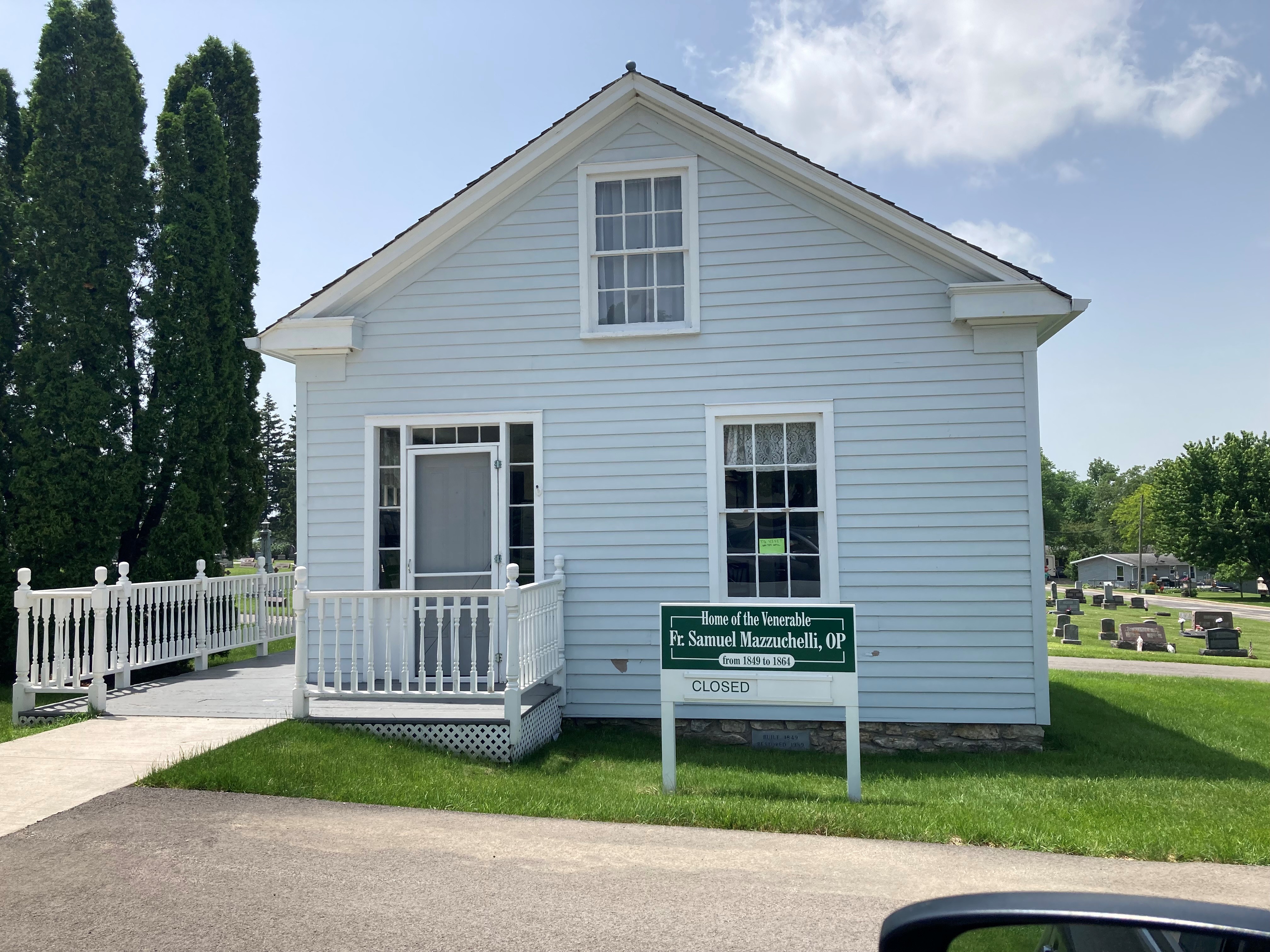
Venerable Father Samuel Mazzuchelli Rectory, Grave -- Benton, Wis.

Destination: Whether planning a day trip or a summer vacation, a stop at Benton, Wis., on Wis. Rt. 81 near the Mississippi in southwest Wisconsin, is worth the detour. Across the street from a park that features a veteran’s memorial is the well-tended final resting place of a pioneer Dominican priest, Father Samuel Mazzuchelli.

Mass is offered at 8:30 a.m. Sundays at St. Patrick Parish. (The parish is served from St. Rose of Lima in Cuba City, Wis., and shares a website; see below.)


Photo: Top -- Venerable Father Samuel Mazzuchelli lived in this tiny rectory in Benton, Wis. It sits at the back of the parking lot on the west side of St. Patrick Parish on Wis. Rt. 81 (Observer photos/Sharon Boehlefeld).

Middle -- Father Samuel Mazzuchelli’s grave is behind St Patrick Church.

Bottom -- Signs on St. Patrick Church in Benton, Wis., explain its history.

Why to go: Father Samuel Mazzuchelli, O.P., now declared venerable, founded several parishes for Bishop Matthias Loras in the Dubuque (Iowa) Diocese, which originally crossed the Mississippi River and included parts of northwest Illinois and southwest Wisconsin. Father Mazzuchelli founded St. Michael Parish in Galena in 1832, the oldest in what would become the Rockford Diocese.

In the grave behind St. Patrick Parish, Father Mazzuchelli’s grave is surrounded by graves of many of the founding sisters of the Sinsinawa Dominicans, which he also founded. 

Born in 1806 in Milan, Italy, he arrived in the American frontier at age 22. He worked tirelessly for the Church as a Dominican priest until his death from pneumonia in 1864 in Benton.

He was a defender of religious liberty, having fought for the right of Catholic soldiers at Fort Mackinac, Mich., to attend Sunday Mass.

He also designed and built more than 24 churches and civic buildings before his death at the age of 57.

Admission: While the rectory is only open during special events near the anniversary of his death in February, it is possible to visit the grave and look into the rectory at any time.  Call ahead for possible open days.

Accessibility: Nicely leveled walkways make the sites accessible to most. 

(Grand) Kid friendly: If the weather is nice, this is a great place to plan a family picnic on a road trip. 

Info: Address — St. Patrick Church, 237 E. Main St., Benton, WI 53803
Phone — (608) 759-2131
Websites — (church) https://strosecubacity.weconnect.com/
(history) https://www.sinsinawa.org/mazzuchelli/mazzuchelli.html

— Sharon Boehlefeld wrote this story after visiting Benton, Wis.  

Send Destination ideas to seasonedobserver@rockforddiocese.org